Healthcare Automation

What Is an AI Receptionist for Healthcare Practices and Why Does It Matter?

An AI receptionist helps healthcare practices manage routine patient communication, reduce repetitive work, and support front-desk teams across the patient journey.

Borna TeamAugust 202610 min read
Healthcare front desk team supported by AI-powered patient communication
  • Published:August 27, 2026
  • Author:Borna Team
  • Category:Healthcare Automation · Patient Communication · AI Reception
The Technology Explained

How an AI Receptionist for Healthcare Actually Works

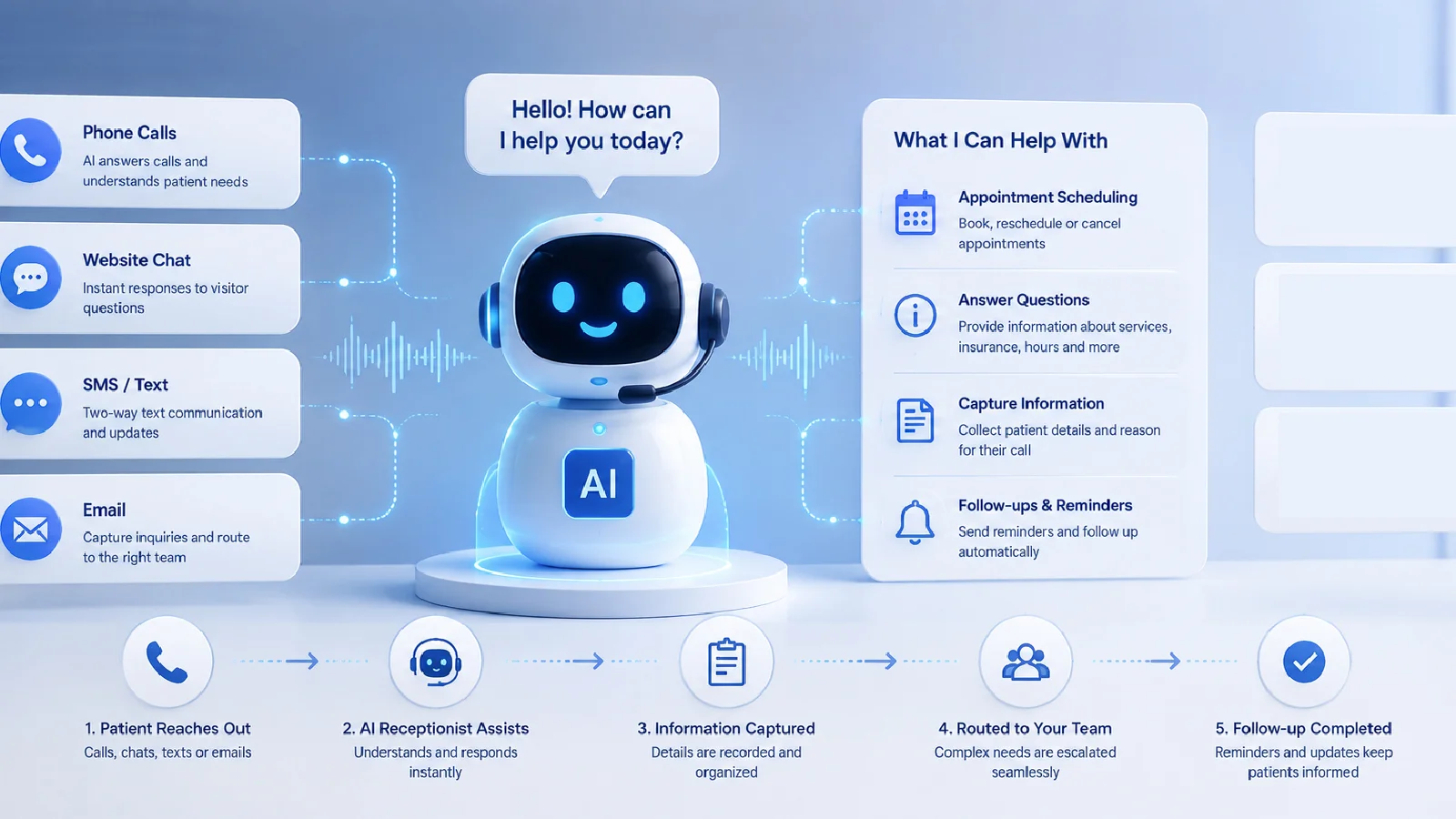
An AI receptionist for healthcare is a technology designed to support routine patient communication and front-desk workflows. Depending on the platform, it can help answer incoming calls, understand why a patient is calling, provide appropriate information, assist with appointment scheduling, and capture details for follow-up. Instead of every interaction depending on an available employee at that exact moment, AI can provide another communication layer when staff are helping patients, answering other calls, or unavailable after regular office hours. The purpose is to improve access while reducing repetitive administrative pressure.

The technology becomes more valuable when it connects with broader healthcare workflow automation. A patient's journey may involve a phone call, appointment scheduling, digital forms, chat, SMS, payments, and later follow-up. When these interactions happen in disconnected systems, staff must manually reconstruct what happened and determine the next step. An AI healthcare operations platform can help organize these interactions into a more connected experience, giving teams better context and visibility while making it easier for patients to move from an initial question toward an appointment or another appropriate next step.

However, an AI receptionist should not be confused with a replacement for healthcare staff. Patients still need people for sensitive conversations, unusual scheduling situations, clinical questions, and interactions requiring empathy or professional judgment. Effective AI healthcare automation creates a better division of work. Technology supports repeatable administrative processes, while front-desk and clinical teams remain responsible for conversations requiring human understanding. For practices, the goal is not to automate every interaction. It is to determine where automation can improve access, consistency, and operational efficiency without weakening the patient experience.

The strongest AI receptionist model combines automation with human support, allowing technology to manage appropriate routine interactions while staff focus on conversations requiring empathy, judgment, and personal attention.

Expert Insight
AI-assisted healthcare communication workflow on a screen
The Upside

Five Benefits of AI Receptionists for Healthcare Practices

Used appropriately, an AI front desk can improve communication efficiency while helping staff stay focused on higher-value patient needs.

01

Capture More Patient Calls Consistently

Patients may call while staff are checking someone in, helping another caller, or completing administrative work. An AI front desk for healthcare can provide additional coverage for appropriate calls, capture why a patient contacted the practice, and make that interaction visible. This reduces dependence on voicemail and gives staff better context when follow-up is required.

02

Extend Communication Beyond Office Hours

Patients do not always contact practices between traditional business hours. Some call during lunch, after work, or while researching providers in the evening. AI-assisted call handling can provide another way to capture patient needs when the front desk is unavailable, helping the practice avoid leaving every after-hours inquiry dependent on voicemail and next-day manual review.

03

Reduce Repetitive Front-Desk Tasks

Front-desk workload often consists of hundreds of small repetitive actions. AI summaries, digital self-service, appointment support, and organized communication can reduce some of this manual work. Instead of repeatedly reviewing calls or reconstructing patient context, staff can access clearer information and concentrate on conversations, exceptions, and patient needs that genuinely require their attention.

04

Improve Follow-Up Visibility and Accountability

A missed call is only one part of the problem. The larger risk occurs when nobody knows whether the patient received a response. Patient communication software can make unresolved requests easier to identify and manage. Better visibility helps teams understand which interactions require attention, while managers gain a clearer view of communication workflows without depending entirely on memory or handwritten notes.

05

Create a More Connected Patient Journey

Patients may call, chat, schedule online, complete forms, make payments, and communicate again before their visit. When these activities remain disconnected, the experience becomes harder for staff and patients. Combining AI patient communication with digital self-service can create greater continuity, helping practices understand previous interactions and giving patients convenient ways to complete routine steps.

Healthcare team using connected patient communication tools
Key Insight

An AI receptionist creates the most value when it does more than answer a call, it helps move appropriate patient interactions toward a clear, visible, and manageable next step.

The Risks

Five Risks Healthcare Practices Should Consider Before Adoption

AI can strengthen communication, but successful adoption still requires clear boundaries, connected workflows, and appropriate human oversight.

Healthcare practice team reviewing AI communication workflows

Automating Conversations That Need People

Sensitive concerns, complaints, complex scheduling, and emotional conversations often need human support. Clinics should automate routine interactions while providing clear paths to staff when personal assistance is needed.

Treating AI Like Clinical Staff

An AI receptionist should support administrative communication, not diagnose conditions or recommend treatment. Clinical questions and decisions must remain with appropriately qualified healthcare professionals.

Adding Another Disconnected Technology

A standalone tool can create another communication silo. Practices should prioritize technology that connects calls, scheduling, messages, and follow-up instead of adding another system staff must constantly monitor.

Losing Personal Patient Communication

Too much automation can make healthcare communication feel impersonal. Technology should reduce repetitive work so staff have more time for reassurance, problem-solving, and meaningful patient conversations.

Implementing Without Staff Alignment

Technology is less effective when responsibilities are unclear. Staff need simple workflows for reviewing AI information, handling follow-ups, managing escalations, and taking over conversations when human assistance is required.

AI supports administrative communication; clinical decisions remain with qualified healthcare professionals.

Borna editorial guidance

Human Escalation Must Stay Clear

AI works best when patients and staff have a clear path to human assistance. Complex, sensitive, or unexpected situations should move outside automated workflows so qualified team members can provide appropriate support.
Head-to-Head

AI Receptionist vs Traditional Front-Desk-Only Patient Communication

The differences become clearer when both models are compared across common healthcare communication and administrative responsibilities.

FunctionTraditional Front Desk OnlyAI-Supported Front Desk
Incoming callsStaff availability dependentAdditional AI coverage
Missed callsVoicemail and callbacksAI-assisted capture
After-hours callsUsually delayedAdditional coverage
Caller intentManually identifiedAI-assisted identification
Call documentationStaff notesAI summaries
Call reviewReplay conversationsReview transcripts/summaries
Appointment schedulingStaff-ledDigital and AI-assisted options
Patient formsStaff-supportedDigital self-service
Patient messagesSeparate channelsConnected communication
Follow-upMemory or manual tasksOrganized workflows
Communication historyOften fragmentedGreater centralized visibility
Complex situationsHuman staffHuman staff

AI works best as an additional operational layer, handling appropriate repeatable communication while healthcare staff remain available for complex, sensitive, and high-value patient interactions.

Decision Guide

When Should Your Practice Use AI Reception Support?

✓ Consider AI-Supported Reception

  • Your practice frequently misses incoming calls.
  • Patients regularly contact you after hours.
  • Staff spend significant time reviewing calls.
  • Follow-up depends heavily on manual processes.
  • Routine communication interrupts in-office patient service.

⚠ Keep Human Staff at the Center

  • A patient has a sensitive concern.
  • Questions require qualified clinical guidance.
  • Scheduling circumstances are unusually complex.
  • A patient needs reassurance or empathy.
  • An interaction falls outside established workflows.
Borna's Approach

How Borna Supports an AI-Powered Healthcare Front Desk

Borna approaches AI reception as one part of a connected patient journey. Borna Connect supports AI-assisted call handling, call intelligence, SMS, chat, and follow-up management, while Borna Care supports scheduling, digital forms, payments, and patient self-service. Together, these capabilities help practices reduce repetitive communication work while maintaining greater visibility into what patients need and what should happen next.

  • AI-assisted call handling provides additional support when front-desk employees cannot answer.

  • AI summaries help teams understand conversations without repeatedly reviewing entire call recordings.

  • Online scheduling gives patients convenient digital access to available appointment options.

  • Digital forms reduce repetitive paperwork and simplify pre-visit information collection.

  • Patient chat and SMS expand communication beyond traditional phone-only interactions.

  • Follow-up management keeps unresolved patient requests visible and easier to organize.

Healthcare team using Borna for AI-assisted patient communication
AI Search Visibility

AI Receptionists and the Future of Healthcare Discovery

Patients increasingly use conversational search experiences to research healthcare providers, compare services, and understand how practices operate. Instead of searching only for a provider name or service, someone may ask whether a clinic offers online scheduling, how after-hours calls are handled, or what communication options are available. Clear, structured website content helps both patients and AI-driven search systems understand those capabilities. This creates an opportunity for practices adopting AI for dental practices, medical offices, chiropractic clinics, and other healthcare settings. Content should answer real operational and patient questions rather than repeatedly inserting technology keywords.

ChatGPTGoogle GeminiPerplexityMicrosoft CopilotClaude

Answer real questions about patient communication and scheduling.

Explain available digital patient access options in detail.

Use structured headings with direct, understandable answers.

Keep clinic services and contact information consistently updated.

Publish useful content around healthcare automation and communication.

Better AI visibility begins with useful information. Practices that clearly explain their patient experience give both people and emerging search systems better context.

FAQ

Frequently Asked Questions About AI Receptionists in Healthcare

Answers to common questions healthcare practice owners and managers ask about AI reception, patient communication, and front-desk automation.

An AI receptionist for healthcare is a technology that supports routine administrative communication between patients and healthcare practices. Depending on its capabilities, it may assist with incoming calls, identify caller intent, support appointment scheduling, capture information, or organize follow-up. It is best used alongside front-desk employees rather than as a replacement for them. Human staff remain important for sensitive conversations, complex scheduling, clinical questions, and situations requiring empathy or judgment. The purpose of an AI receptionist is to make appropriate routine communication easier to manage while giving staff greater visibility into patient needs.

Ready to Grow?

Give Your Front Desk Smarter Support With Borna

An AI receptionist should make patient communication easier without removing the human support healthcare requires. Borna combines AI-assisted communication, scheduling, digital forms, payments, chat, and follow-up workflows to help practices reduce repetitive work and create a more connected patient experience.

  • AI-Assisted Communication
  • Connected Patient Journey
  • Human-Centered Automation
Borna product capabilities referenced from the user-provided Borna blog and product materials. borna.ai